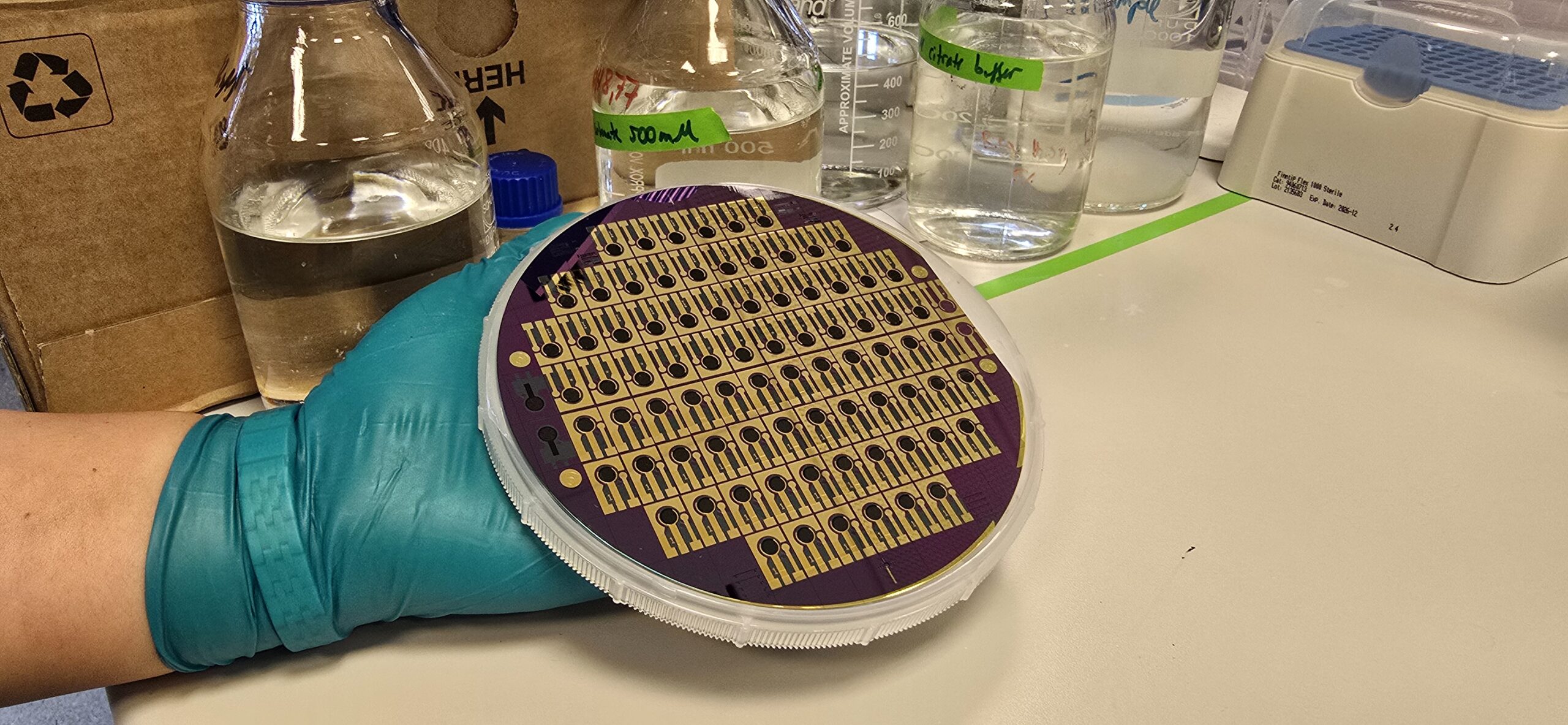
This pilot project brings together DTU-led innovation in the form of pioneering real-time electrochemical sensors for bioprocess monitoring and microdrop Technologies expertise in high-precision inkjet dispensing. The collaboration aims to demonstrate how inkjet-based fabrication workflows can be integrated into next-generation sensor chip production for measuring small molecules (e.g. glucose) in fermentation and cultivation systems.
The project team will develop and validate a modular, automated fabrication process combining DTU’s advanced micro/nano sensor expertise with microdrop’s high-throughput dispensing capabilities. Specifically, they will demonstrate the feasibility of using inkjet printing to functionalise and protect 3D-structured electrochemical sensors with nanomaterials in a reproducible and scalable way.
By integrating microdrop’s dispensing systems into real sensor fabrication use cases, the project will provide proof of concept highlighting:
-
- the microdrops system’s suitability for complex sensor workflows,
- the integration potential with high-sensitivity and antifouling sensor designs, and
- the practical performance of printed sensors in bioprocess conditions.
For further information about this HALRIC pilot project, please contact:
Pedram Ramin
DTU Chemical Engineering
pear@kt.dtu.dk
Marc-Manuel Hahn
microdrop Technologies
marc-manuel.hahn@microdrop.de