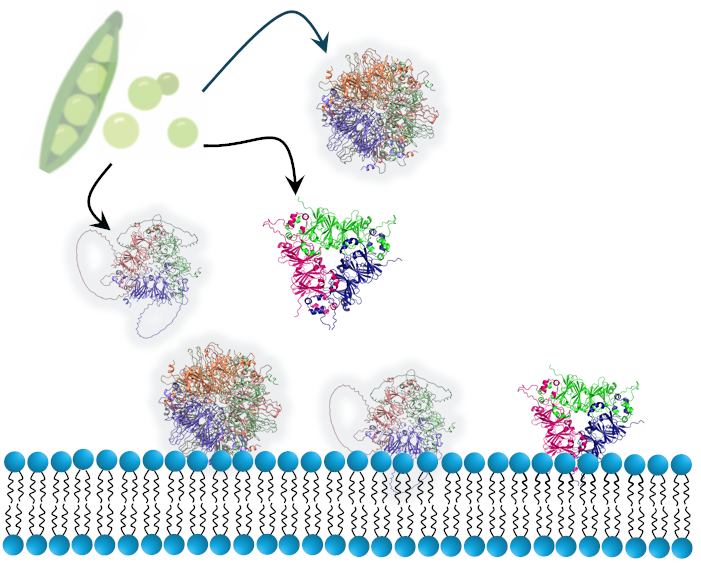
In response to the growing global demand for sustainable and diverse food sources, the shift from animal to plant based proteins has gained significant momentum.
Among these, pea proteins stand out for their favorable nutritional profile, functional versatility, and reduced environmental impact. The major storage proteins in pea—legumin and vicilin—constitute around 50% of the total protein content in isolates, with albumins contributing 8–20%. These proteins not only serve as key food ingredients but also as model systems for other legume proteins relevant to the green transition and bioeconomy.
This HALRIC pilot project investigates how co-extracted lipid contaminants, derived from the seed, affect the structure and functionality of pea protein fractions under varying pH and temperature conditions. While often regarded as “minor” contaminants, these lipids may significantly impact protein properties, with notable consequences during formulation, processing, and digestion.
Using pea protein as a model, we will employ a cross-border, multiscale approach combining SAXS, nanoDSC, and SR CD on purified fractions. Experiments will be carried out at Malmö (MAU) and Aarhus Universities (AU), with advanced characterization at MAX IV (CoSAXS) and ASTRID2.
Our goal is to derive general principles of plant protein–lipid interactions to aid the design of healthier, more functional, and sustainable plant-based foods, with broader relevance to applied biology and food innovation.
For further information about this HALRIC pilot project, please contact:
Antara Pal
Malmö University
antara.pal@mau.se