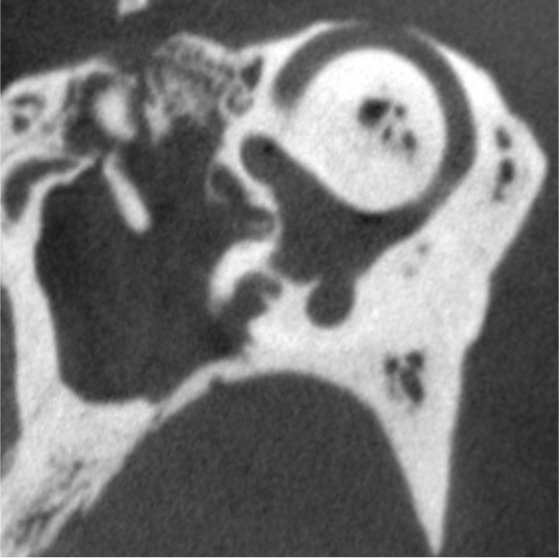
The temporal bone contains important anatomical structures relating to hearing and balance, including the cochlea and the vestibular organs, such as the semicircular canals. Superior Semicircular Canal Dehiscence (SSCD) syndrome is a rare auditory and vestibular disorder with an underlying cause related to the complex anatomy of inner ear structures. SSCD syndrome is a disabling condition in which the loss of bone between the superior semicircular canal (SSC) and the dura of the brain affects the sense of equilibrium and sound transmission.
Continuous advancements in clinical imaging modalities enhance diagnostic capabilities. However, accurately diagnosing SSCD based on imaging remains a clinical challenge. Although clinical imaging is used alongside auditory and vestibular tests to support the diagnosis, conventional high-resolution CT may overestimate the presence of SSCD. Newer clinical imaging modalities, such as cone-beam CT (CBCT) and photon-counting CT (PCCT), have a higher spatial resolution and may be able to visualise the SSCD pathology more accurately with relatively low radiation exposure.
This HALRIC pilot project will compare the imaging capabilities of two clinical imaging modalities (CBCT and PCCT) and two micro-CT scanning modalities (high-resolution micro-CT and photon-counting micro-CT) on temporal specimens with different SSC bone thicknesses from the Otopathology Lab (Rigshospitalet). Finally, a histological assessment of the SSC will be performed to provide a reference standard for comparing the range of modalities applied.
This HALRIC pilot project is significant because it has the potential to advance our understanding of the diagnostic imaging capabilities of newer, emerging clinical imaging modalities, such as CBCT and PCCT, in assessing SSC of the temporal bone.
For further information about this HALRIC pilot project, please contact:
Bilal Hussain Akram
Rigshospitalets Copenhagen Hearing & Balance Centre
bilal.hussain.akram@regionh.dk