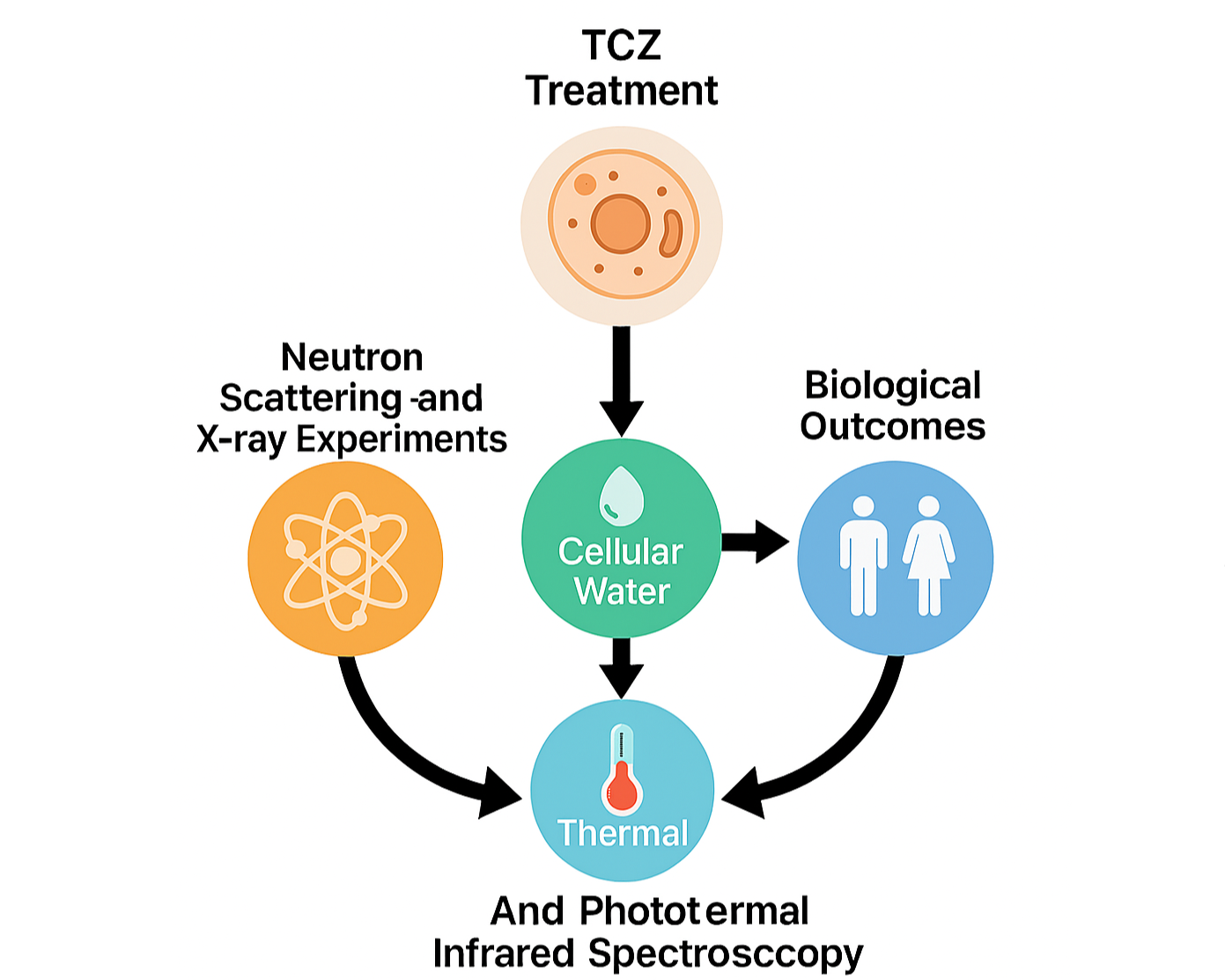
Predicting cellular behavior before and after treatment involves various approaches, yet gaining insights into these responses remains one of science’s greatest challenges. The functionality of a living cell is controlled by the interplay of its many components. Although progress has been made in understanding individual cell parts, fragments and enzyme levels, our understanding of cells as a whole is still lacking.
Interestingly, despite being mainly composed of water, the properties of cellular water have not yet been fully explored as indicators of cellular characteristics. The crowded nature of the cellular environment means that the properties of water molecules can vary considerably based on their surroundings. For example, water that interacts minimally with other molecules exhibits bulk water behaviour, whereas water confined by folded proteins and membranes — referred to as interface water — displays distinct properties.
In this project, we will investigate how the structure and dynamics of lung cells and their surrounding water molecules change after treatment with the monoclonal antibody tocilizumab (TCZ), either in its free form or incorporated into a bio-nanoparticle. We propose employing an integral approach, combining neutron and synchrotron X-ray scattering experiments with thermal analysis and optical photothermal infrared spectroscopy, to correlate changes in cellular water with biological outcomes resulting from TCZ treatment.
By leveraging the expertise of researchers from large-scale facilities such as MAX IV and ESS, as well as groups at the University of Copenhagen and Photothermal Spectroscopy Corp., we aim to enhance our understanding of how a newly developed bio-nanoparticle functions as a potential drug delivery system for tocilizumab.
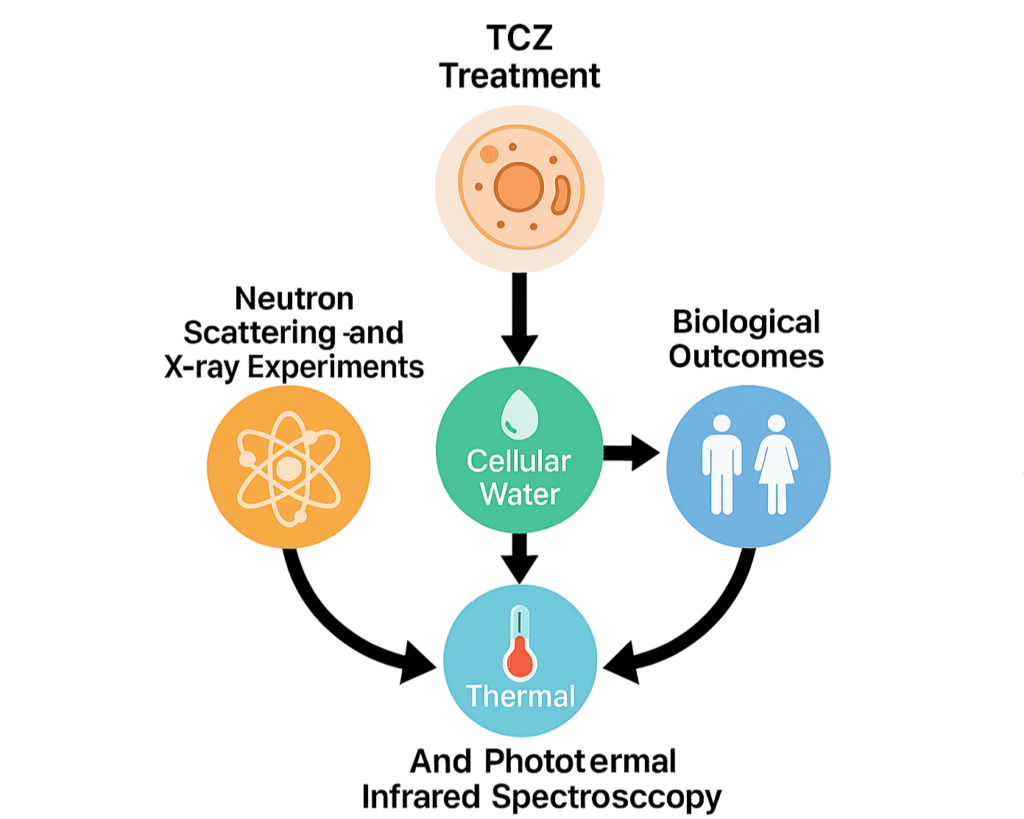
Figure “Nano Warriors: tocilizumab takes flight to fight inflammation”
For further information about this HALRIC pilot project, please contact:
Heloisa N. Bordallo
University of Copenhagen
bordallo@nbi.ku.dk