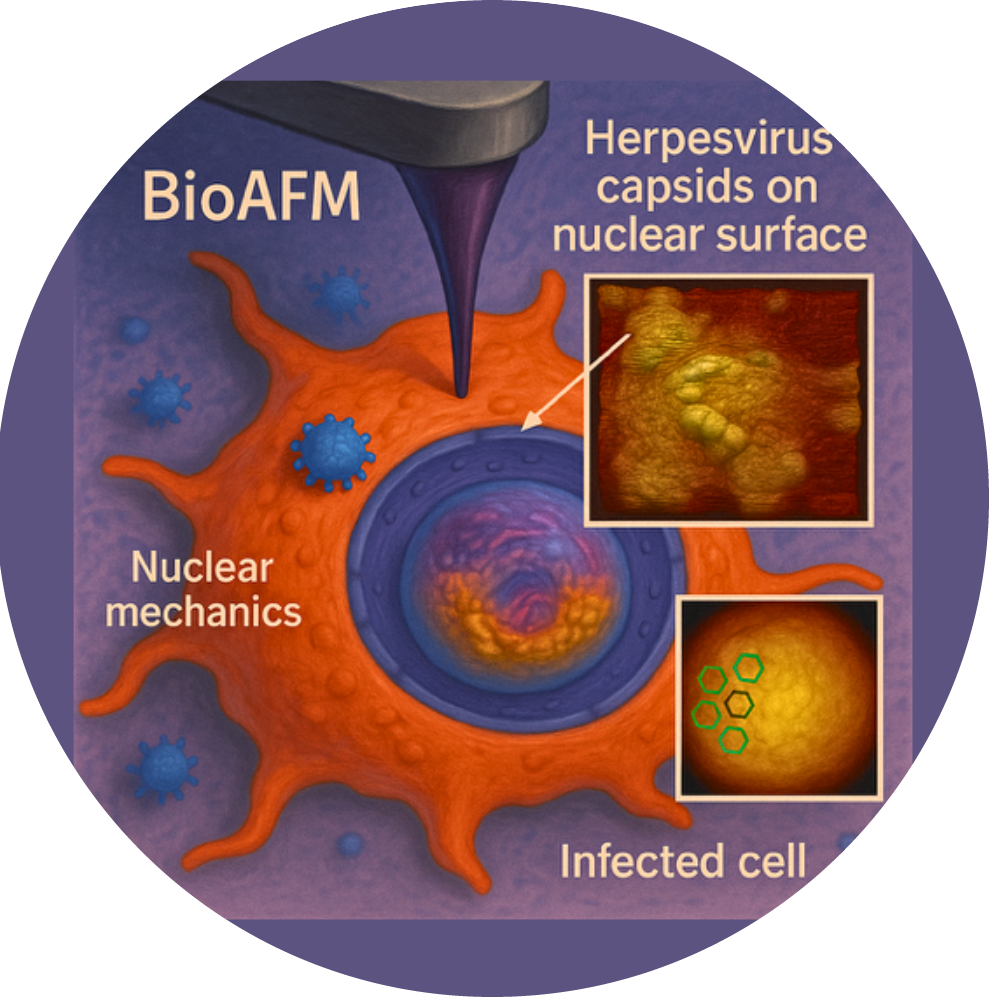
Understanding how nuclei withstand mechanical stress is essential, because both cancer invasion and viral infection exploit these forces in ways that shape disease progression.
Cells are exposed to dynamic biomechanical forces that are transduced through a host of mechanosensitive proteins. The nucleus integrates these forces into behavioral outputs that determine cell function, fitness, and fate. This relies on intrinsic force-responsive elements at the nuclear envelope (NE) (elasticity) and chromatin (viscosity) level that control the ability of nuclei to withstand and adapt to forces. Forces place tremendous strain on integrity of cell nuclei during invasion.
To cope, cancer cells adapt nuclear properties through a process called mechano-adaptation, enabling migration through dense micro-environments. At the same time, these adaptations predispose cancer cells to nuclear fragility and NE ruptures, major catalysts of cancer evolution. During herpesvirus infection, viral capsids eject pressurized DNA into nuclei, accompanied by chromatin stiffening and NE softening. This mechano-adaptation is critical to prevent NE rupture under stress imposed by viral DNA.
As such, cancer invasion and herpesvirus infection both challenge NE integrity and exploit nuclear mechano-adaptation to mitigate damage. In this project, the team combines genetics, live microscopy, and bio-atomic force microscopy (AFM) to quantify and manipulate nuclear mechano-adaptation in cancer and infection models. Correlative AFM–fluorescence and force mapping will reveal how mechanoadaptation protects NE integrity.
By comparing models, this HALRIC pilot project aim to uncover shared mechanoprotective principles and identify common targets for intervention.
For further information about this HALRIC pilot project, please contact:
Coen Campsteijn
University of Oslo
coen.campsteijn@medisin.uio.no
Alex Evilevitch
Lund University
alex.evilevitch@med.lu.se