Democratic forums like Folkemødet (Denmark), Almedalsveckan (Sweden), and Fehmarnbelt Days (Germany/Denmark) are more than lively civic gatherings. They are essential arenas for shaping the future of collaboration, research infrastructure, and innovation across the Øresund-Kattegat-Skagerrak-Hamburg region.
With tens of thousands of participants attending these events every year, including policymakers, researchers, civil society actors, and engaged citizens, they provide an unmatched opportunity for both visibility and dialogue.
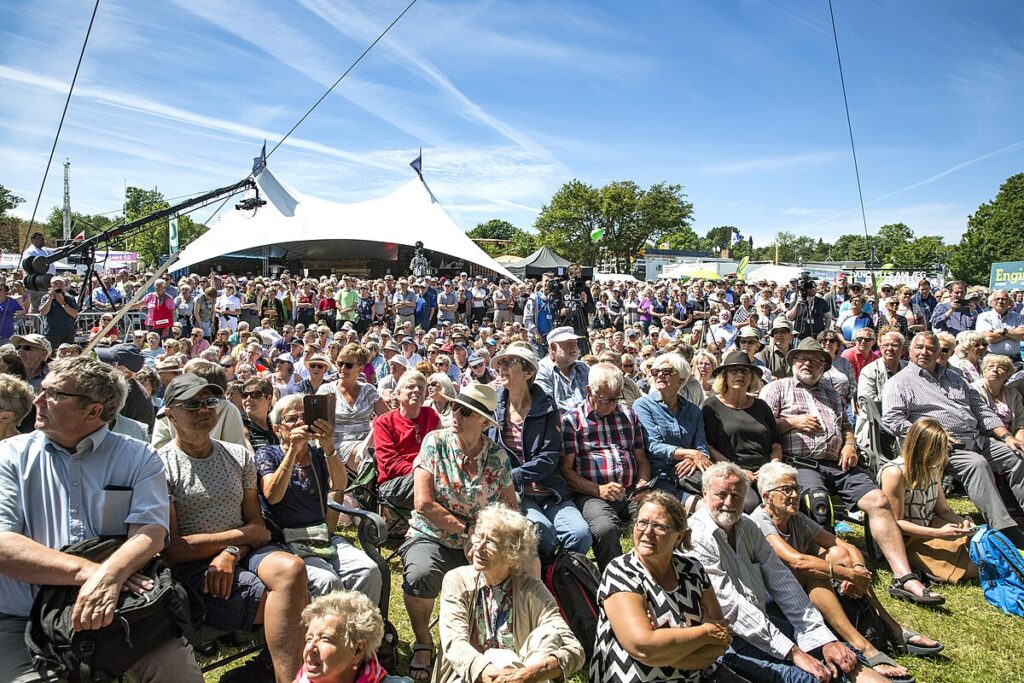 © News Øresund – Sofie Paisley (CC BY 3.0).
Presenting HALRIC pilot projects
At Folkemødet 2025, our partner from Rigshospitalet took part in a session hosted by the Danish Cancer Society, showcasing HALRIC pilot projects in cancer research. The event brought to life how cutting-edge facilities like MAX IV and ESS are already accelerating medical research through cross-border collaboration. By connecting Danish clinical researchers with world-class synchrotron and neutron sources in Sweden, HALRIC is enabling new insights into diagnostics, surgical precision, and treatment development.
With over 60,000 participants attending Folkemødet annually, these public events serve not only to share scientific breakthroughs but also to engage citizens and stakeholders with the societal impact of research infrastructure. They are proof of how local health challenges can be addressed through international science.
Internal reflection and national mobilisation
Meanwhile, Almedalsveckan 2025 offered our partner from Lund University an important opportunity to engage with Swedish stakeholders and decision-makers on strategic questions, for example on how to stimulate broad Swedish engagement with world-class facilities like ESS and MAX IV despite limited resources or how could a national industrial PhD school focus on synchrotron and neutron methods provide the next wave of talent.
These questions must be tackled together across academia, industry, and government, and democratic forums provide exactly the right environment for such nuanced conversations.
Connecting regions through celebration and strategy
In Lübeck, during the Fehmarnbelt Days 2025, HALRIC was again on the map, this time thanks to Klaus von Lepel, our partner from the Ministry for Science and Research Hamburg, who presented the consortium’s vision and achievements in a panel on Baltic innovation ecosystems. A key message delivered to the panel was that startups and researchers need early access to research infrastructure, and that regional innovation requires critical mass and cross-border talent mobility.
In this setting, HALRIC’s work is a natural example of how European projects and Interreg-supported collaborations are already delivering value.
From dialogue to direction
Whether presenting medical breakthroughs, raising national policy questions, or feeding into strategic discussions about regional development, HALRIC is showing how research infrastructure consortia can both benefit from and contribute to democratic dialogue. The future of research and innovation in the Øresund-Kattegat-Skagerrak-Hamburg region depends on keeping these conversations alive, inclusive, and connected.