2025 marked 30 years of Sweden’s EU membership and 25 years of the Öresund Bridge. At EU Days Lund 2025 (23–24 September), one message stood out: Europe’s future depends on how well we cooperate across borders.
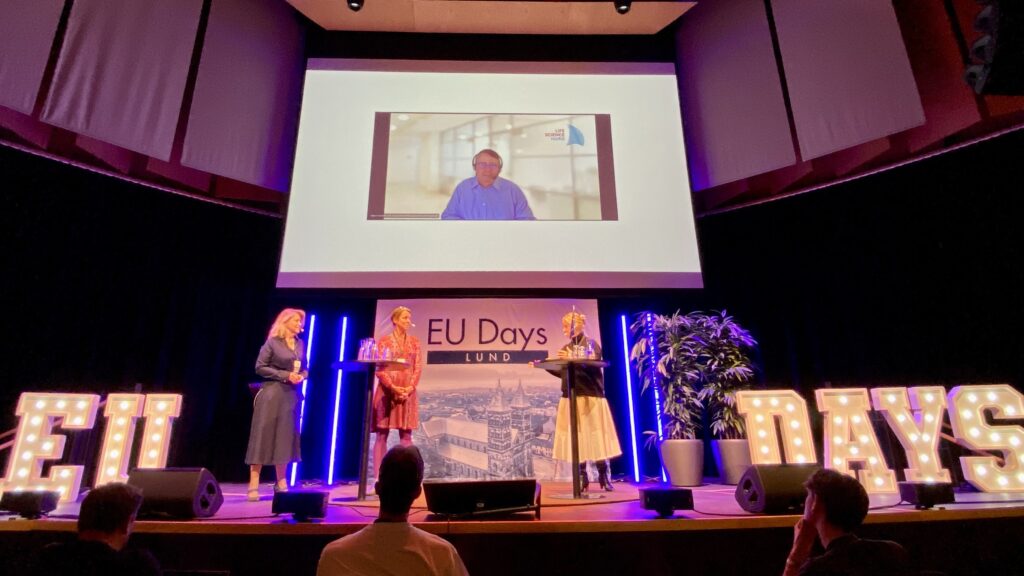
Over two inspiring days in Lund and online, policymakers, researchers, and industry leaders came together to explore the future of the European Union and what it will take to strengthen competitiveness, innovation, and cohesion in a changing world.
Unlocking the Fehmarn Belt Fixed Link
HALRIC contributed to the session “Unlocking the Fehmarn Belt Fixed Link: Boosting Competitiveness and Innovation in a New Cross-Border Region.” The focus was practical and forward-looking: what happens when a new connection doesn’t just move people and goods, but also helps regions share talent, infrastructure, ideas, and opportunity?
During the session, HALRIC representatives pointed to one clear takeaway: make cross-border work the default by:
- Making more of the infrastructures we already have: Kajsa M. Paulsson (HALRIC Project director, Lund University) highlighted how Interreg funding has been essential in a region with a high density of state-of-the-art research infrastructures. With the Fehmarn Belt Fixed Link, the region has a chance to maximise access and usage across borders — and turn proximity into deeper, more systematic collaboration.
- Shifting mindsets from national to European: Anette Steenberg (CEO, Medicon Valley Alliance) reflected on Mario Draghi’s observation that Europe too often struggles to think across borders because of national mindsets. The Fehmarn connection, she argued, offers a real opportunity to challenge that reflex and replace it with more integrated, cross-border approaches in how we plan, fund, and work.
- Giving industry more speed and more reasons to collaborate: From an industry perspective, Oliver Schacht (Managing director, Life Science Nord) underlined what faster connections can mean in practice: quicker transportation, a more attractive region for companies and talent, and better conditions for firms to collaborate, build partnerships, and pursue new opportunities across the new corridor.
Why this matters for the life science region
The Fehmarn Belt Fixed Link is often described as infrastructure, but the bigger story is what it enables. When travel becomes smoother and collaboration becomes simpler, it becomes easier to:
- share and scale access to research infrastructures
- connect start-ups, investors, and industry across regional clusters
- build cross-border partnerships that last beyond single projects
- create a region that is more competitive, resilient, and attractive internationally
For HALRIC, this is exactly the point: real impact happens when we connect the right people and places and make cross-border cooperation the easy choice, not the exception. A big thank you to everyone who joined us in Lund and online. We left EU Days Lund 2025 energised, and even more committed to strengthening a connected European life science region.
Learn more