Through direct dialogue with the European Commission and Member States, HALRIC’s Brussels discussions showed how cross-border life science collaboration can unlock efficiency, strengthen European competitiveness, and underline the urgent need for continuity beyond short project cycles.
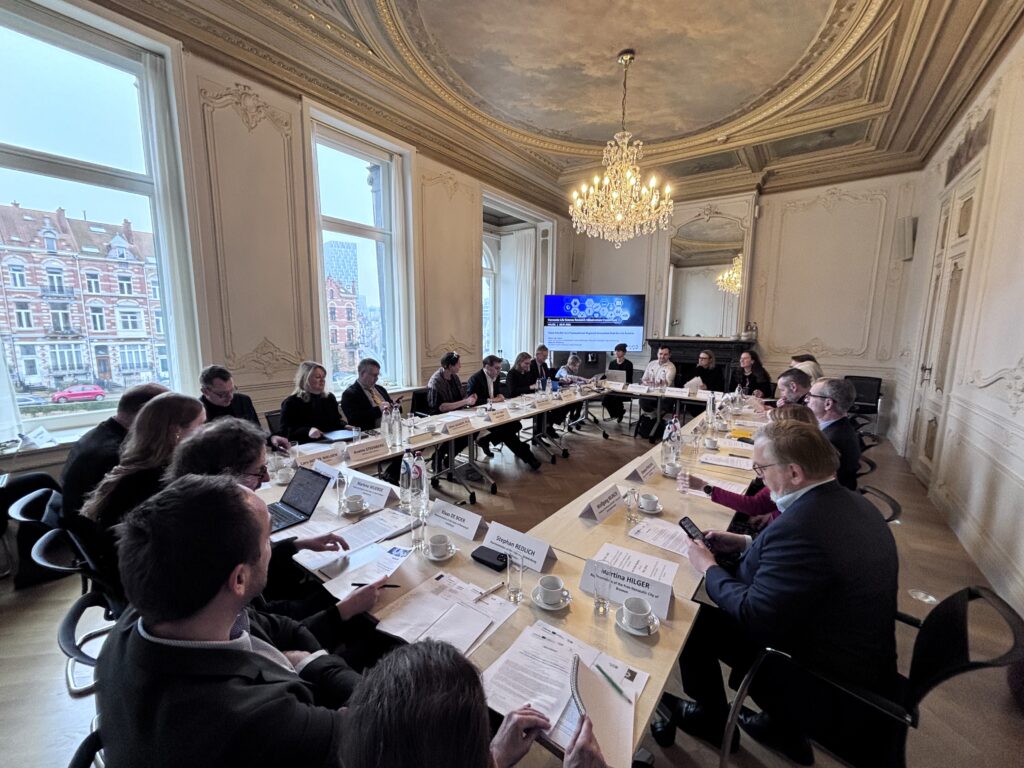
Last week in Brussels, HALRIC brought together policymakers, research leaders, funders and regional actors for two complementary conversations: a policy-focused lunch briefing with the European Commission and Member State representations, followed by a public evening panel session on “Northern European Synergies: Building a World-Class Competitive Life Science Region Together“.
These discussions were about confronting and actively working to prevent a structural challenge Europe continues to face: how to turn world-class scientific excellence into sustained competitiveness, patient benefit and economic impact.
The meetings brought together senior representatives from the European Commission and multiple Member States. Participants included members of the Cabinet of Commissioner Zaharieva (Research & Innovation), senior officials from DG REGIO, and research counsellors from the Permanent Representations of Denmark and Norway, alongside regional authorities from Germany and Sweden.
Northern Europe hosts one of the world’s densest concentrations of advanced life science research infrastructures, leading universities and hospitals, innovative SMEs and globally competitive industry. Facilities such as ESS, MAX IV, European XFEL and DESY represent long-term public investments of strategic importance to Europe. As a life science centre of excellence, it is also attracting interest beyond the European Union. One example is the recent collaboration with the UK’s National Institute for Health and Care Research (NIHR) through the launch of a Nordic Virtual Office.
This external interest reinforces a central point raised in Brussels: when excellence clusters at this scale, discontinuity is no longer a local risk, but a European one. Without systemic connectivity across borders, sectors and funding instruments, much of this potential remains underused.
This strategic context helps explain why HALRIC has emerged not only as a project, but as a model for cross-border collaboration.
HALRIC as a living blueprint
We should really learn from the HALRIC project. I would even call it a blueprint, because it shows how smooth cross-border cooperation and collaboration can unlock efficiency gains that we simply wouldn’t achieve working nationally.
Alexandra Hild, Cabinet of Commissioner Ekaterina Zaharieva, DG RTD, European Commission
The strong interest from the European Commission and Member State representatives confirms that HALRIC’s experience is considered relevant well beyond the scope of a single Interreg project.
Since 2023, HALRIC has brought together 21 partners across Denmark, Germany, Norway and Sweden in a shared effort to activate Europe’s strongest research assets through cross-border pilot projects. To date, the consortium has delivered more than 80 pilot projects, many involving industry and clinical partners, and enabled new user communities (particularly SMEs and clinicians) to access facilities that would otherwise remain out of reach.
What matters most, however, is not the number of pilots, but what they demonstrate:
- that cross-border collaboration can work at scale
- that research infrastructures can function as shared European innovation engines
- that aligning academia, healthcare, industry and regional authorities creates measurable value
These discussions should also be seen in the context of HALRIC’s sustained policy engagement over recent months. Since early 2025, partners in the consortium have actively contributed to the European debate on the future of life sciences, including a joint input in April outlining how Europe can better connect research infrastructures, funding instruments and innovation ecosystems in a forthcoming EU life science strategy (more info).
The discontinuity risk
Despite strong alignment, political interest and proven results, HALRIC now faces a familiar European problem: discontinuity.
Short project cycles, followed by multi-year gaps between funding programmes, are fundamentally misaligned with how research, infrastructure use and innovation ecosystems function. As several participants noted, three-year projects followed by long pauses are not compatible with global competition. Nor with the pace of scientific and technological development.
Participants underlined a shared concern: without mechanisms to bridge successful initiatives into more permanent structures, Europe risks losing momentum precisely where it still holds global leadership.
The European Commission would like to “create a Champions League of Europe’s best ecosystems and really incentivise cooperation and connectivity while reducing the burdens currently experienced.”
Europe needs continuity, speed and structural alignment. This means:
- longer time horizons for cross-border collaborations
- better alignment between EU, national, regional and philanthropic funding
- governance models that allow successful initiatives to scale rather than stop
- willingness to treat life sciences as a strategic competitiveness domain, not just a research field
Avoiding this discontinuity is now a core focus of HALRIC’s work: through continued dialogue with EU institutions, Member States and regions, our task now – and the work already underway – is to ensure that proven models are carried forward, strengthened and embedded into the next generation of European innovation policy.