
The HALRIC final conference marked the culmination of three years of cross‑border collaboration to strengthen access to life science research infrastructures across the Öresund–Kattegat–Skagerrak–Hamburg region.
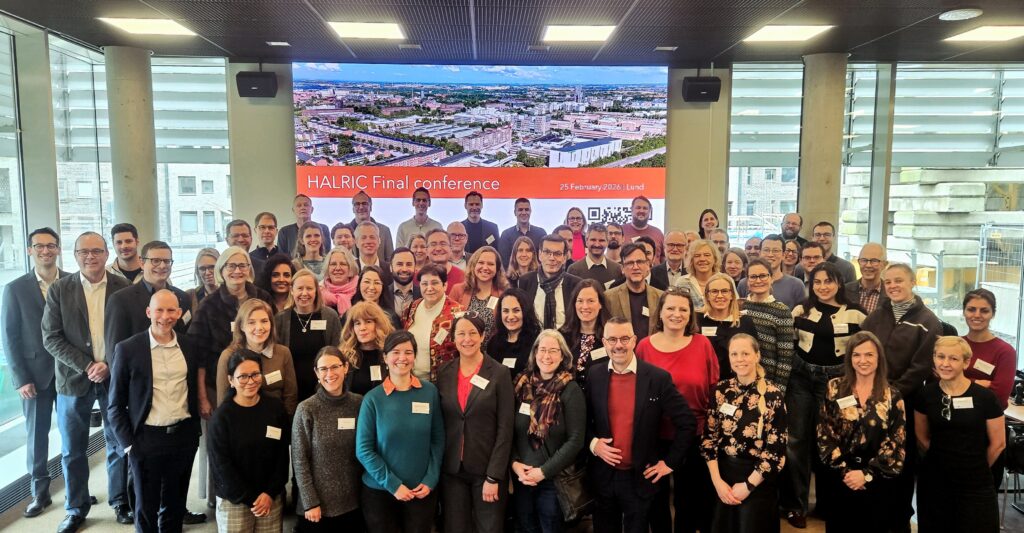
Held in Lund in February 2026, the conference brought together more than 100 participants, from project partners, researchers and infrastructure providers to policymakers and regional stakeholders.
Rather than looking backwards alone, the two‑day event created space for shared reflection, concrete examples of impact, and forward‑looking discussions about how cross‑border collaboration around research infrastructures can evolve into more durable frameworks.
Opening access and lowering barriers
The main conference day opened with the session “Unlocking access: HALRIC’s journey with Research Infrastructures”, moderated by Petter Hartman, CEO of Medicon Village Innovation. Kajsa M. Paulsson, HALRIC Project Director at Lund University, and Maria Sundh, HALRIC Head of Project Operations at Medicon Valley Alliance, revisited the core ambition of HALRIC: turning access to large‑scale research infrastructures into something that is practically usable for researchers, clinicians and companies across borders.
The HALRIC project video shown during the session helped visualise what this means in practice, translating three years of coordination, matchmaking and pilot activity into concrete examples of collaboration.
What became clear throughout the event was that access alone is not enough.
As Erik Renström, Vice-Chancellor, Lund University put it, drawing on the Hanseatic tradition that inspired HALRIC’s name:
“The Hanseatic tradition is rooted in cooperation across borders, trust between partners, and long‑term mutual benefit — a powerful model for how we should respond. (…) In a fragmented world, trust becomes a competitive advantage.”
Pilot projects stories
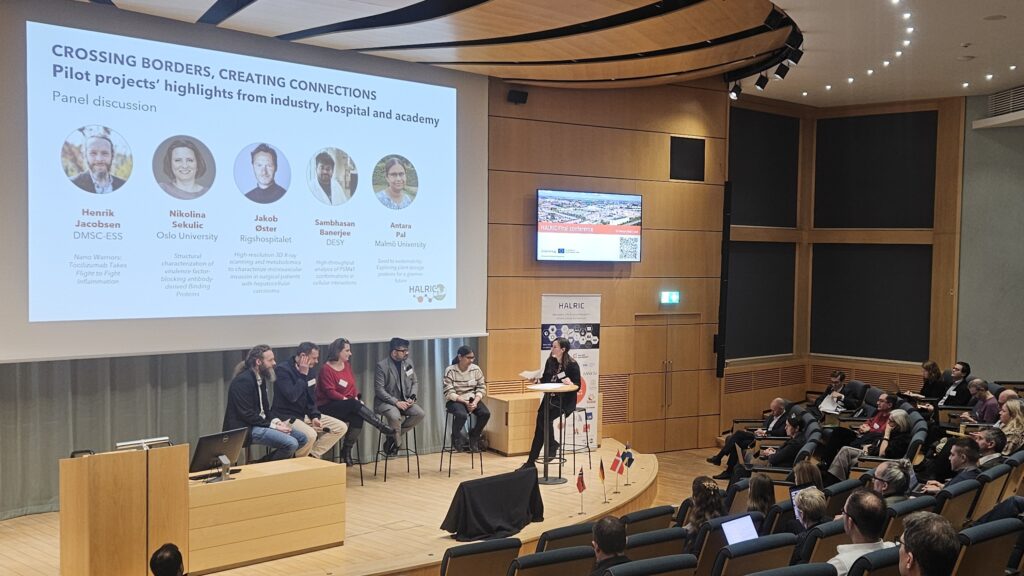
If the morning established the “why”, the late‑morning session “Crossing borders, creating impact” demonstrated the “how”. Moderated by Veronica Lattanzi, HALRIC Co‑director at Lund University, the session showcased pilot projects spanning industry, hospitals and academia, each illustrating how cross‑border access to infrastructures translated into scientific and clinical value.
Among the examples was hospital‑led work presented by Jakob Øster (Rigshospitalet), combining high‑resolution 3D X‑ray imaging and metabolomics to study microvascular invasion in liver cancer patients. As Øster explained, the motivation is deeply clinical:
“Now we take biopsies, but in most cases they are taken almost randomly, and we are not really sure if we are picking up the right one. (…) We are dreaming about seeing the whole organ down to the cellular level and back again.(…) We haven’t cured any diseases yet, but the potential is huge.”
Other presentations — spanning neutron‑based industry projects at ESS, structural biology, infection research and sustainable plant science — illustrated the breadth of disciplines engaged through HALRIC’s pilot model. In total, HALRIC launched more than 80 pilot projects, exceeding its original target, including 28 projects with industry partners and 19 with direct clinical relevance.
What unified these stories was not a single technology, but a shared mechanism: short, focused collaborations that lowered the threshold for engaging with advanced facilities across borders. Furthermore, several speakers emphasised that infrastructure alone does not create collaboration: people do. This theme of active coordination ran throughout the day and became particularly important in discussions about sustainability beyond the project period.
Data, analysis and shared infrastructure
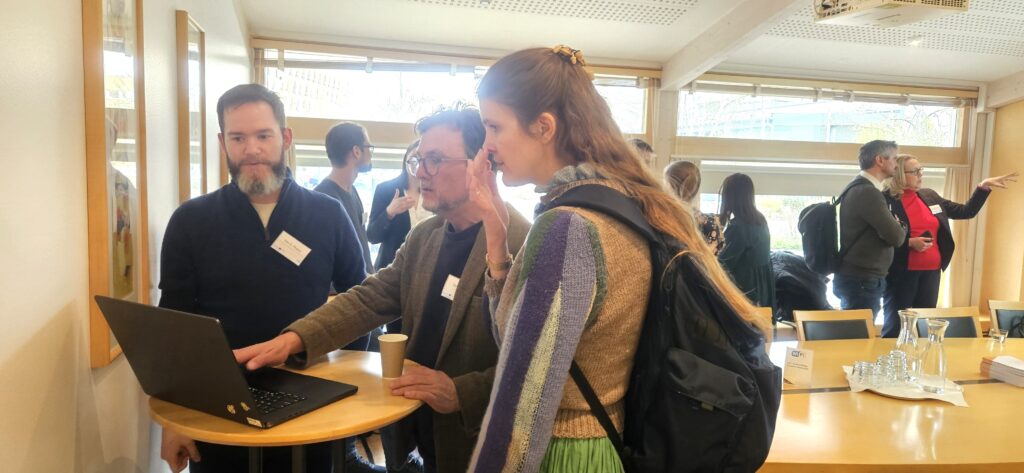
Data and analysis emerged also repeatedly as a central theme. During the lunch break, participants explored posters and live demonstrations, including the Hanseatic Science Cloud prototype, supporting secure data management and cross‑border collaboration.
As Anders Bjorholm Dahl (DTU Compute), underlined in his contribution on imaging and data analysis:
“One of the major challenges in imaging is coping with data that is hundreds of gigabytes — or even terabytes — in size.(…) You don’t do that on a local laptop.”
The longer‑term innovation perspective and importance of research infrastructures was reinforced by Franz Hennies, who highlighted measurable effects:
“More than one in ten publications based on data from large‑scale research infrastructures will eventually be cited in a patent. (…) This shows that the impact of what we do is long‑term and measurable.” (1)
Effective cross‑border data collaboration requires more than a shared vision. It depends on clear steering structures, dedicated financial resources, and sustained institutional commitment across a critical mass of research infrastructures. HALRIC has shown that ambition must be matched by operational responsibility and long‑term buy‑in to be effective. Within this context, the Hanseatic Science Cloud (HSC) prototype has served as a concrete test case. It has been part of ongoing discussions — including with LUNARC, Lund University’s HPC centre — exploring options for how the prototype and its learnings could inform a future long‑term portal solution beyond the project framework.
From project results to a lasting structure: the HALRIC Science Hub
The closing session, “Looking ahead: sustaining collaboration and curiosity‑driven research”, brought these threads together. The discussion made clear that HALRIC should be seen not as an endpoint, but as part of a longer trajectory building on earlier initiatives such as MAX4ESSFUN and HALOS.
Looking ahead, Arwen Pearson (University of Hamburg) captured both ambition and urgency:
“We should dream big.(…) The breadth of people I’ve been able to engage with through HALRIC was totally unexpected.(…) We shouldn’t be scared of lobbying for what we need to deliver this.”
These discussions fed directly into the presentation of the HALRIC Science Hub, conceived as the continuation of HALRIC’s coordination model. Rather than another time‑limited project, the Science Hub is designed as a permanent, cross‑border brokerage and coordination function, preserving the capacity, trust and experience built over three years.
In that sense, the Final conference served less as a closing chapter than as a pivot point. The strongest message was one of continuity, summed up simply by Kajsa M. Paulsson in the final moments of the day:
“We have done so much together and we really should continue.”
More information about the Final conference:
https://halric.eu/final-conference
References: