
News & Events

News

Seeing cancer in 3D at MAX IV Open Day

Oct 1, 2025

MAX IV Open Day 2025 welcomed visitors of all ages to explore one of Europe’s most advanced research infrastructures. Among the highlights were two HALRIC pilot projects demonstrating how micro-computed tomography (micro-CT), a powerful 3D X-ray imaging method, can advance cancer diagnosis and treatment.
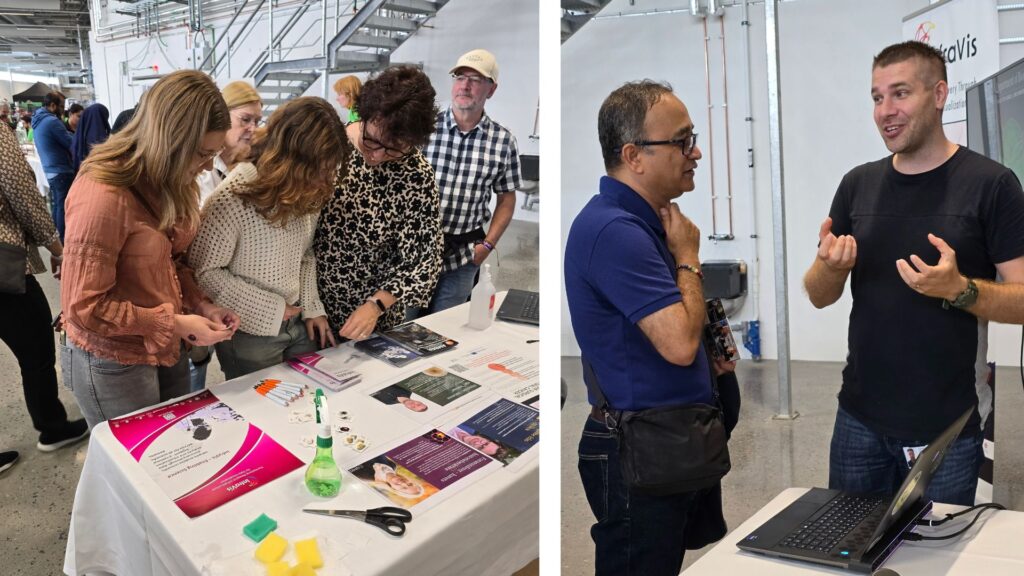
 

More than 300 visitors stopped by during the day, sparking engaging conversations about how X-rays and neutrons help us see the invisible, from ancient artefacts to living tissue.

At the Infravis stand, Emanuel Larsson, Co-Director at LINXS and researcher at InfraVis and Lund University, presented how cross-border collaboration within HALRIC can bring new imaging tools to clinical practice. Visitors learned how researchers are using synchrotron-based micro-CT at MAX IV to obtain ultra-detailed 3D images of tumour tissue.

2025_MAX-IV-Open-Day_HALRIC-A3-WEB

3D X-ray to improve cancer treatment

Two ongoing HALRIC pilot projects were featured, exploring whether micro-CT can:

  • detect microvascular invasion before surgery, a key factor in predicting if liver cancer will return.
  • give surgeons sharper 3D images of tumours, helping them achieve safe surgical margins and reduce complications for oral cancer.

Both projects combine expertise from MAX IV Laboratory, Lund University, University of Copenhagen, DTU, and Rigshospitalet. Together, they show how hospitals and universities can join forces to bring advanced research closer to patient care.

A warm thank you to Emanuel Larsson for representing HALRIC at MAX IV Open Day, and for engaging so many visitors in conversations about how science, collaboration, and technology can improve healthcare. And a special thank you to the pilot project teams for their close collaboration in developing the poster and ensuring that the research could be presented in an engaging and accessible way for all visitors.

Learn more

Download

Hanseatic Science Cloud Workshops

On 4 and 20 November, the HALRIC WP3 Hanseatic Science Cloud (HSC) team, together with HALRIC Ambassador Emanuel Larsson, held two online workshops with invited researchers from Lund University, MAX IV, Oslo University, SciLifeLab, and DESY Hamburg. [pdf-embedder...

A match for success: HALRIC at the Nordic Life Science Days 2025

The biggest life science breakthroughs have one thing in common: they don’t happen in isolation. That was the spirit of Nordic Life Science Days 2025, where HALRIC brought a simple message into the room: we are stronger together. Photo: Sarah Niemann and Petter...

EU days Lund 2025: HALRIC on the Fehmarn Belt’s potential

2025 marked 30 years of Sweden's EU membership and 25 years of the Öresund Bridge. At EU Days Lund 2025 (23–24 September), one message stood out: Europe’s future depends on how well we cooperate across borders. Over two inspiring days in Lund and online, policymakers,...

Save the date: HALRIC Final conference

We are pleased to announce that the HALRIC Final Conference will take place on 24–25 February 2026 in Lund, Sweden. The event will mark the culmination of three years of cross-border collaboration to strengthen access to life science research infrastructures in the...

Over 75 pilot projects funded through HALRIC

HALRIC just hit a major milestone: 26 new pilot projects have been selected in our latest call, bringing us past our goal of funding 75 cross-border Life Science collaborations in the Öresund–Kattegat–Skagerrak–Hamburg region. These new projects span a wide range of...

Building HALRIC’s legacy: milestones and momentum towards 2026

As the HALRIC project enters its final phase, the team behind Work Package 4.2 is finalising a paper on how to strengthen the region as a life science innovation hub. The paper outlines strategic recommendations for enhancing cooperation and building a transnational...

Next steps for the Hanseatic Science Cloud prototype

In May and June 2025, HALRIC’s Work Package 3 team pushed the Hanseatic Science Cloud (HSC) prototype into the spotlight. Designed to connect researchers with powerful computing and data resources across the region, the HSC sparked discussions this summer on how the...