The state-of-the-art facilities at Lund University provide unique resources and expertise to advance research in Life Sciences and material science. BioSAXS and LU-Fold were inaugurated in 2023 and are open to foster collaborative projects and advance scientific discovery through cutting-edge technology and expertise.
‘We want to promote the usage of X-ray and neutron scattering techniques and provide the researchers in academia as well as in industry with a facility where it is possible to measure macromolecules in solution and serve as a gateway environment to the large scale infrastructures,” says Professor Marie Skepö, who is behind one of the first HALRIC pilot projects – a proof of concept study with European XFEL and MAX IV to understand intrinsically disordered proteins by combining scattering and imaging techniques.
The LU-Fold facility is dedicated to predicting protein structures using the AlphaFold2 method, recognized as Nature Methods’ Method of the Year in 2021.
“It was initially a local facility, but we now welcome international collaborations through HALRIC and other networks,” says Gemma Atkinson, LU-Fold Director, and she further refers to how the facility has already supported a variety of collaborative research projects. These include identifying virus protein interactions with the human proteome, predicting oligomers of bacterial cell division proteins, discovering binding partners associated with childhood cancer neuroblastoma, and investigating brain protein interactions linked to neurological disorders.
LU-Fold specializes in high-throughput prediction of protein complexes, providing invaluable insights into protein-protein interactions. The facility uses high-performance computing clusters to predict structures for hundreds or thousands of protein complexes.
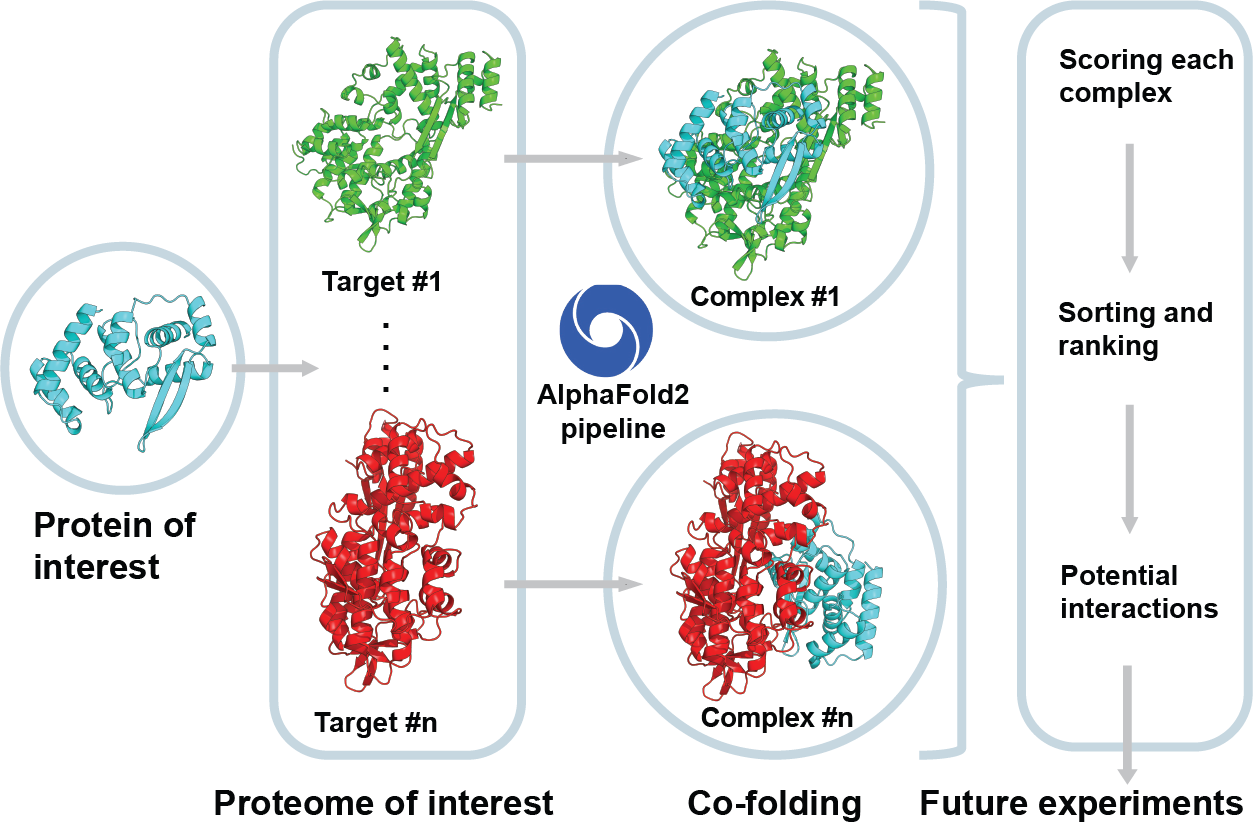
Schematic overview of a typical LU-Fold run: The sequence of a protein of interest is co-folded with a proteome of interest (two proteins of the proteome are shown here). Each protein-protein complex is scored with the pDockQ and iPTM scoring metrics and ranked. This provides insights into potential interaction partners and guide future experiment design.
BioSAXS: A Hub for Macromolecular Analysis
The BioSAXS (Solution X-ray Scattering Instrument for Life Science and Soft Matter) is a crucial tool in Life Science, designed to study macromolecules in solution under near-physiological conditions. Funded by LU Central, the Science Faculty, and the Faculty of Engineering, this instrument offers a versatile sample environment and high sensitivity, making it a valuable resource.
Lund University’s interdisciplinary approach combines experimental SAXS data with computational techniques, such as bioinformatics, NMR, X-ray diffraction, and cryo-EM, facilitating comprehensive models of biological macromolecules. With powerful software tools for data visualization and analysis, the researchers at LU can also easily interpret scattering data and extract meaningful insights.
“The ability to study molecules in their native environment and the instrument’s integration with other techniques make it indispensable for advancing our understanding of molecular biology, disease mechanisms, and drug discovery. Combined with our expertise in simulating and analyzing SAXS data, we think LU is an ideal partner for collaborative research projects,” comments Professor Marie Skepö.
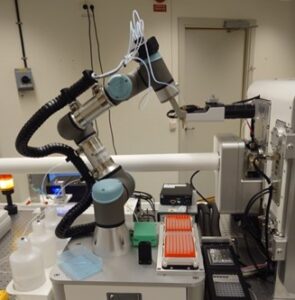
The BioSAXS instrument is equipped with various advanced sample environments, and it ensures excellent data quality even for challenging samples thanks to its pipetting robot for efficient and accurate sample handling, real-time data acquisition, and high-quality detectors.
In 2024/2025, the BioSAXS setup will be further enhanced with high-performance liquid chromatography (HPLC) and asymmetric flow field-flow fractionation (AF4), which will enhance the quality and efficiency of data collection, especially for samples with large components and wide size distributions.
Accessibility and Contact Information
LU-Fold is located in the Department of Experimental Medical Science, in the Faculty of Medicine, and the BioSAXS instrument is located at the Department of Chemistry, in the Faculty of Science. LU-Fold offers tutorials and workshops to help researchers make their own predictions, visualize results, and create publication-quality structures. The facility runs as a service, ensuring that users do not need prior bioinformatics or structural biology experience. For LU Fold services find out more about the services offered and user fees HERE
Researchers can book the BioSAXS instrument for 24-hour use by contacting Professor Marie Skepö or the facility manager of the Center for Scattering Methods, Peter Holmqvist
Find further information on user fees etc. HERE
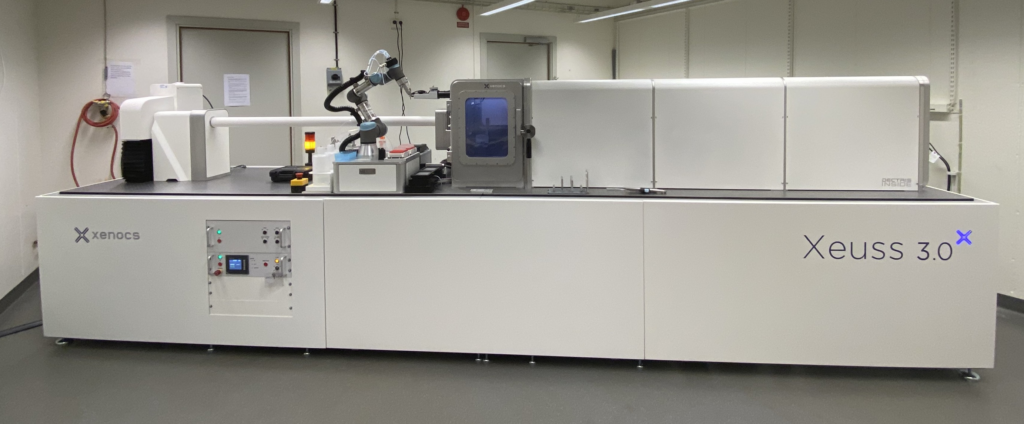
The SAXS instrument is equipped with various sample environments, such as:
• BioCUBE, suited for low sample volume solution scattering with machine vision assisted sample positioning.
• Low noise flow cell for liquid samples, especially useful for dilute or low scattering samples.
• Capillary Peltier stage
• Powders, solids, and gels sample holders.
The instrument is equipped with a BioXolver pipetting robot to be used with the BioCube: